

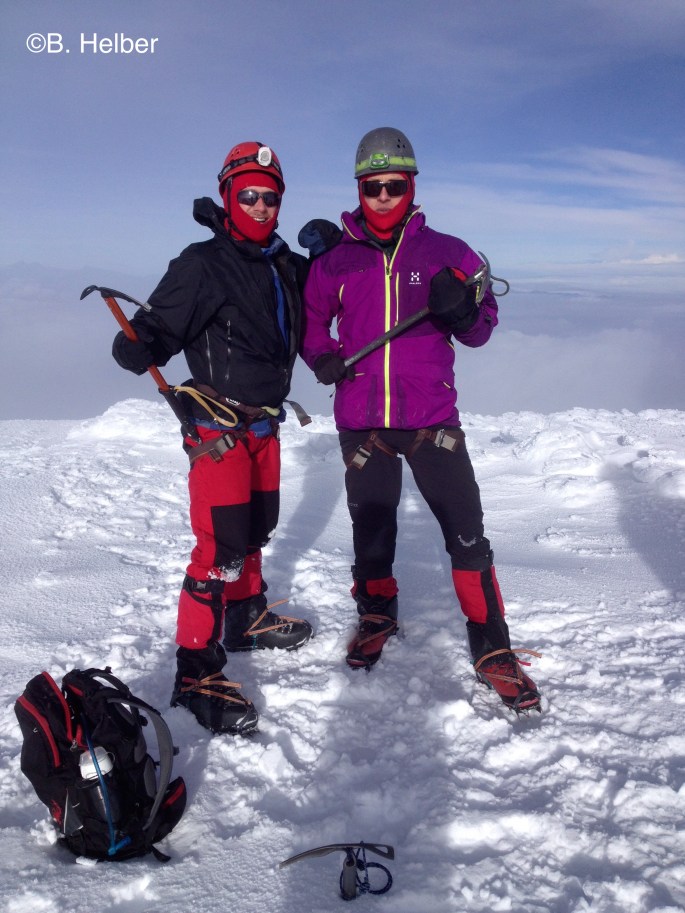
Date: 08 May 2016
Distance: not much but enough
Elev. gain: 1,200 m
Goal: breath in, breath out
Finish: ~10 hours
Shoes: Rented boots and crampons
Ouuff what a thing. I’ve done many races, the toughest ones were a 100km walk in Flanders (actually not a race, but against the watch to fight against a DNF if not finished within 24h) and a 65k trail race in the Alps (Zugspitz Supertrail). But creeping around in the snow and ice, lacking (kind of important) oxygen, that’s the hardest I’ve done so far.
From Quito, we set off in the afternoon of 7 May 2016 at 2pm with a 4WD towards our “Refugio” at 4,600m altitude – a cozy small hut with some bunk beds and an oven, in the “common area”, the sleeping rooms were not heated. Before our nap at sunset, we tried on crampons, ice axe and harness withe ropes to make some trial-walks on the glacier, followed by a small dinner. For some of us. Not for all:
My friend and I had arrived more than one week earlier in Quito (2,800m) and climbed volcano Pichincha (4,698m) on our first day (after taking the teleferico up to 3,954m). Some dizziness, some headache, and very slow movements, but overall quite fine – except for my sprained ankle on the way down due to an incoming thunderstorm and totally soaked clothes for the same reason. A few days later, we embarked on the Quilotoa loop, a four-day hike (depending on where you start and end) in-between 3,000-3,900m altitude. All in all a good preparation for our Cayambe endeavour.
Not so for our two British friends – who were supposed to join our climbing-club. #1 was quite fine once arriving at the refugio, but #2 had to fight altitude thickness. Actually, there wasn’t much to fight….headache, puking, sleeping – he couldn’t do much more; so no dinner for #2.
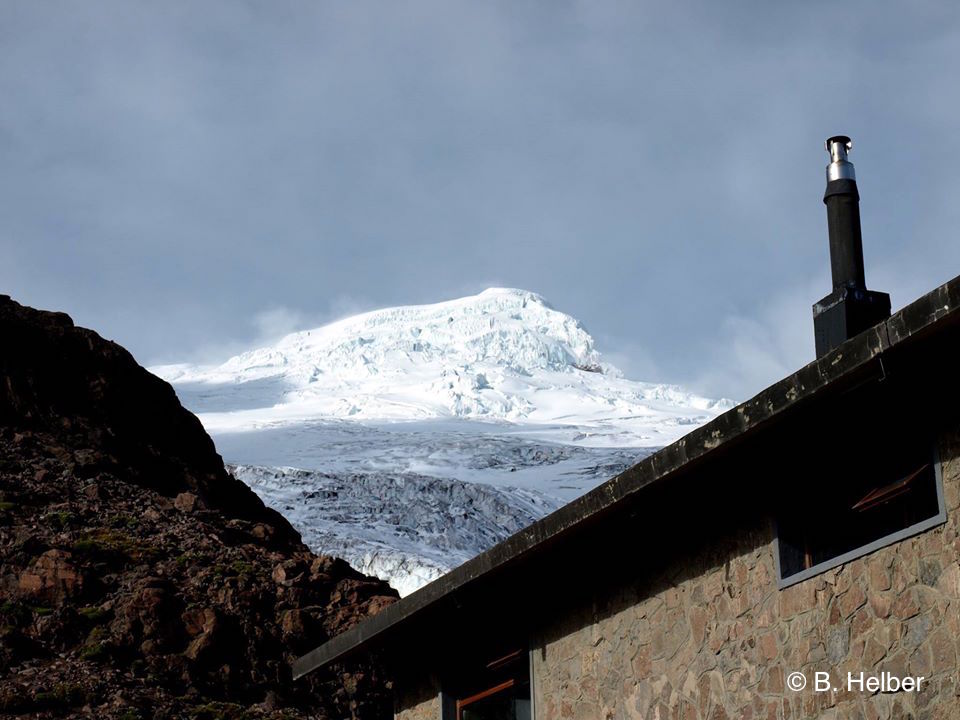
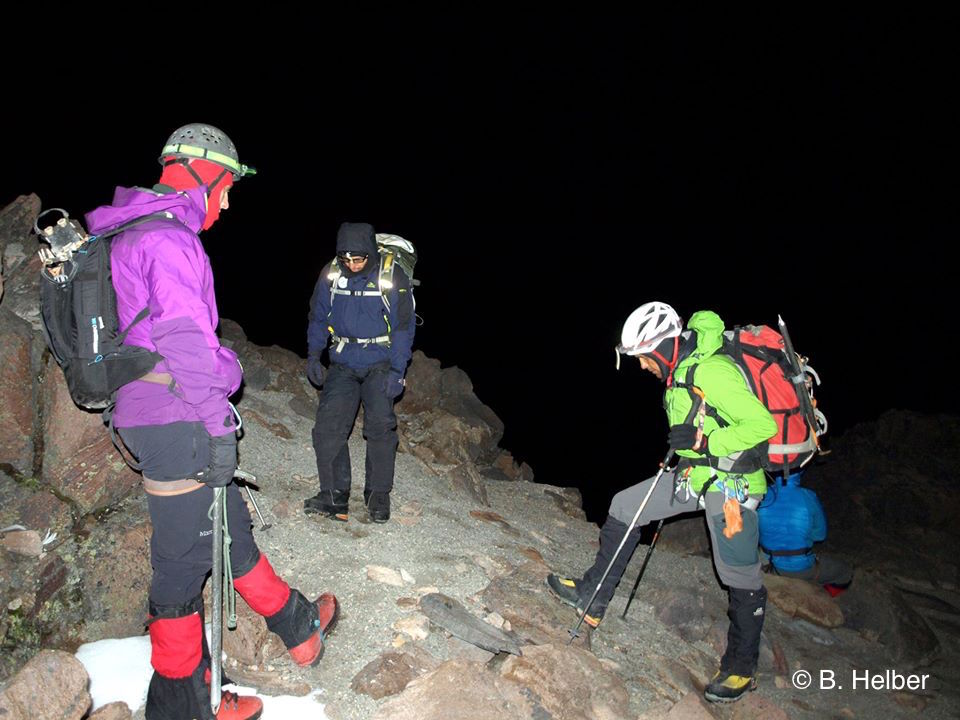
We tried to get a bit of rest before our departure which was scheduled for midnight. But because every minute or so you wake up for a big breath that your body forces you to do, there’s not much sleeping after all…
Half an hour before midnight we got ready and started our hike, first through technical terrain of mainly stones and debris. After two hours or so we reached the glacier and it was time to put the crampons on and roped up – usually two visitors per guide, but as #2 bailed out I was alone with our second guide. In fact, the climb is not very difficult and is more hiking in the snow than true climbing, however, the difficulty (and danger) comes from the many crevasses of the glacier dozens meters of in depth. Without a guide who knows the area well, a simple deathtrap for folks like me.
It was 1.30 am by now, and the night was beautiful, with clear skies, minus 10 centigrade and not much wind. But because it was dark there wasn’t much to see except the 1m of snow ahead of you. Some pathways had already been prepared by earlier hiking groups the night before, but other parts had to be re-established by our guides, especially in the heavy crevasses areas. In those zones, we hiked with a long rope and some distance between each other (it would certainly be bad luck if the whole rope team would break into the same crevasse). In fact, I had to experience a situation when I lost the ground under my feet; all of a sudden, I was stuck deep in the snow up to my waist and just prevented slipping further by heavily driving the axe into the ice and getting a good hold on it. My guide told me to hold still and to use the axe for staying in place. He then positioned himself well and pulled me out of the (presumably small) crevasse.
Another 3 hours or so later the sun came up, amazing and beautiful.
As soon as the first sunlight hits the retina and serotonin is released, a warm feeling of excitement after a long night out swells up in your body cells and the glacier turns into a beautiful deck of snow, with azure blue ice blocks and reeeeally deep crevasses to your left and right. Not to forget the amazing view that makes you feel kind of on top of the world. (fun fact: Cayambe is the highest point on the equator and the only point covered with snow, its peak is the point farthest from the Earth’s axis; thus it rotates the fastest as Earth spins wikipedia). The other higher volcanos Chimborazo and Cotopaxi show up on the horizon, as does a sea of clouds beneath your feet.
Another 100-200m of elevation towards the summit (that meant another 1-2 hours), but then it was done and the views were simply amazing!
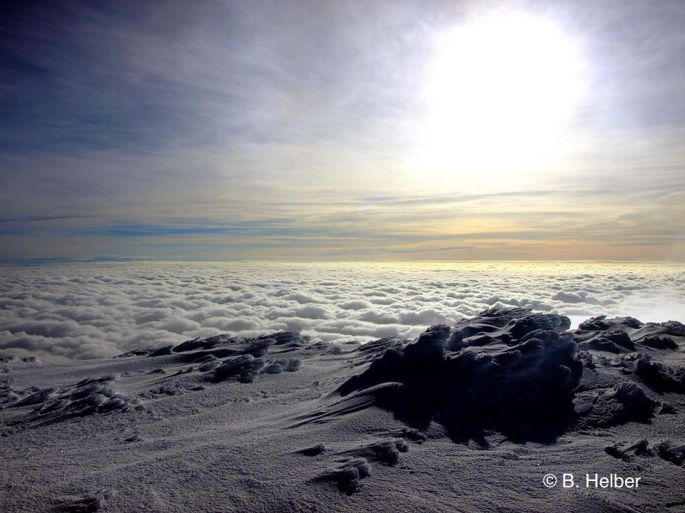
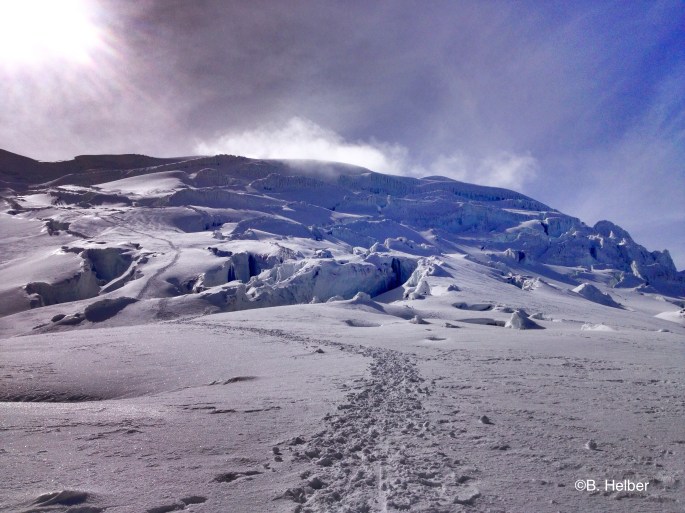
After 20 minutes of rest and enjoying the view we started the descent, which would take us another 3-4 hours. We were hungry, exhausted, and not used to our snow boots with crampons, which gave me terrible chafes on the shin that I just started to realise now. Scheißegal, we made it and just have to get back down, where a warm breakfast is waiting for us.
Around 11 am, after breakfast and collecting our stuff, we jumped into our 4WD, which would bring us down into the town of Cayambe, back to Quito and throw us out along the highway towards Nueva Loja, which was another 7h of bus ride into the Amazonas for our 4-days stay in the Cayaman lodge. Imagine, from minus 10 degrees at 5,700m elevation to 30 degrees at 300m within half a day, what a temperature and oxygen shock :-). Of course, we were totally knackered and slept most of the bus ride….what a day, carpe diem!
For the interested hikers:
We contacted Andeanface for the climb, which were super helpful in setting up everything by email. However, they could not do the climb with us for organisational reasons. Instead they recommended us to go with Condor Trek, which we did.
 Fun.Run.Dad