

We all know the words, aerobic, anaerobic, lactate, lactic acid, anerobic threshold and so on and so forth…but what they exactly mean and why they are important was never fully clear to me – I just had a rough idea what they stand for. But once you better understand their significance you can learn how to profit from them.
I wrote up the summary below as an exercise for myself and as a basic reminder – now I hope it may also help others with some basic understanding.
Contents
1. introduction: THree main energy systems
2. When do we use which system
3. How to use this information in training
4. Common misconceptions
1. Three main energy systems of importance
The only energy source in the body for movements and muscle functions is adenosine tri-phosphate (ATP) and to sustain any exercise, ATP needs to be replenished, what the body can do through the use of oxygen (aerobic) or without (anaerobic).
For us runners, three main energy systems are of importance [neglecting the anaerobic ATP creatine phosphate (ATP CP) system, which delivers very rapid energy for efforts of a few seconds without lactate production]:
- Anaerobic metabolism:
Anaerobic glycolysis (lactate system) produces ATP rapidly from glucose (carbohydrates – CHO) without using oxygen, but for the same reason (being anaerobic), lactate is being produced. The glucose is first broken down into pyruvate + energy, with the pyruvate then converting to lactate and a hydrogen ion if it is not aerobically consumed (see below). Although this system is of importance for the overall performance capability of a runner, it actually plays only a small contribution in races longer than 5-10km. - Aerobic metabolism:
a) Aerobic glycolysis produces ATP by using the pyruvate resulting from the breaking down of glucose (see above) together with oxygen in the mitochondria (the cells power plant). Thus, no lactate is being produced from any remaining pyruvate, energy production is slower than anaerobic but can be sustained much longer (as long as CHOs are available/replenished). Most runners are familiar with this system and most runners are most of the time using mostly this energy system, which is of high importance for half-marathon to marathon performance for most of us (hobby) runners.
b) Aerobic lipolysis produces ATP from stored fats together with oxygen, no lactate is being produced and energy production is still lower than aerobic glycolysis but fat stores are basically unlimited (can be sustained endlessly). This system is always underlying for longer races and low intensities, where ATP production is not required at a high rate. Whereas marathon and ultra runners relentlessly pursue perfection of this system beside increasing the glycogen stores, the hobby runner loves this pace as it combines a low (painless) effort, ability to chat (and sing), and reduces our long-term energy stores (fat) – one of the biggest motivation of some running minds.
The three ATP producing systems are briefly reviewed in the table below:
Beside the lactate production at anaerobic effort, it becomes clear that production rate of ATP is very high for anaerobic glycolysis, but a lot of fuel is needed to produce the same amount of energy compared with aerobic lipolysis.
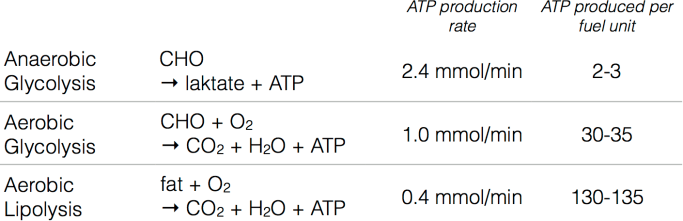
anaerobic exercise brings fast ATP but is not very efficient,
aerobic lipolysis resorting on fats offers high ATP production at slow rate.
One note regarding lactic acid and lactate production:
Very often, those two terms are used exchangeably but there is a chemical difference between the two, with lactate missing one proton. As the name says, lactic acid is acidic and therefore able to donate a proton (or hydrogen ion, H+). In the human body, lactic acid immediately breaks down into lactate (the conjugate base of lactic acid) and a proton, which means that lactic acid is probably not present in our body. The origin of this reaction again is the glycolysis, creating pyruvate, which is then further broken down either into CO2 and water if oxygen is available (aerobically) or into lactate through lactate dehydrogenase in the absence of oxygen (anaerobically).
How the lactate can then be cleared out again will not be treated here for the moment.
At this point it is important to understand that all ATP producing systems are in a constant interplay with each other (also referred to as energy continuum) and are always working at the same time. However, the prevailing ATP source depends mainly on the fitness level of the athlete as well as on intensity and duration. Another factor can be nutrition before/during activity (full, depleted, refilled glycogen stores).

2. When do we use which system
The next important question is, at which state of running the body resorts mainly to which system for producing energy. An answer to this question can help us to tweak our training, not only in terms of running duration and speed, but also regarding nutrition during the run as well as before and after training. If we can actually get to know the heart rate or pace at which one system prevails over another one, one individual can get a very good idea at which intensity to train for an optimised return of investment. In fact, this does not only mean that one single training run can be targeted towards one specific energy system, it also allows us to identify which system is underdeveloped and requires more attention for an overall improvement.
As learned above, lactate starts building up in our blood stream once anaerobic glycolysis is becoming active, producing ATP from carbohydrates without oxygen. Therefore, the blood concentration of lactate during increasing exercise serves well to explain the different thresholds, as can be seen in the curve below (another question is whether such analysis – carried out in a medical laboratory – serves well to determine those zones).
I have highlighted the lactate concentration curve over various heart rate values from resting to maximum heart rate. In addition, two colorbars indicate the lactate production (red) and its clearance (green) from the blood stream; as long as both bars remain at the same height, the body is at steady state and can remove the lactate at the same rate as it is being produced, that means lactate does not build up.
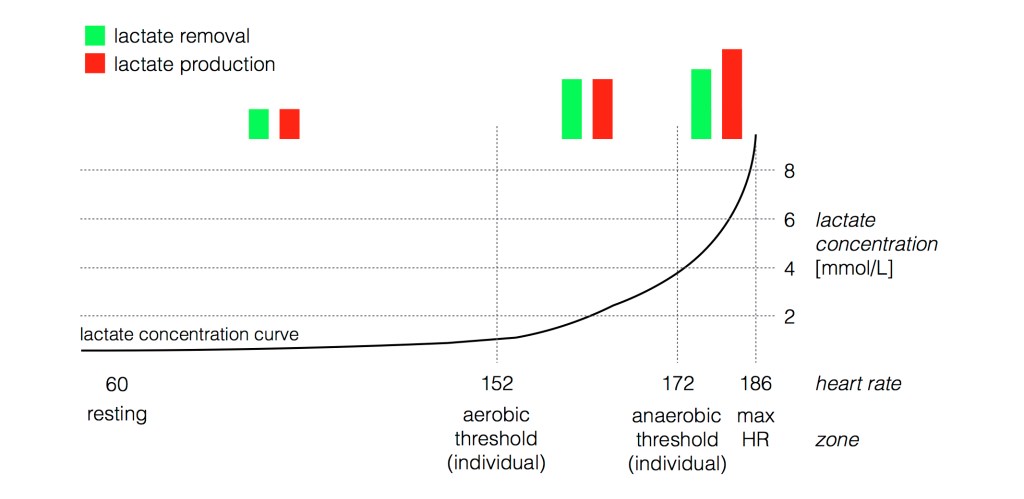
Even at rest, some lactate circulates in the blood, approximately on the order of 1 mmol/L. This concentration stays constant when we start exercising, where energy is dominantly produced from fat burning (aerobic lipolysis) and is solely aerobic. At increasing intensity, the body relies more and more on the consumption of carbohydrates and also starts ramping up anaerobic energy production in the muscles, producing lactate. This starting point of anaerobic energy production when lactate is flushed into the bloodstream but still cleared by the body at steady state is sometimes referred to as individual aerobic threshold (with lactate concentration levels on the order of 2 mmol/L). It also refers to the crossing point of energy production from fat (lipolysis) to carbohydrates (glycolysis): Above the aerobic threshold, more energy is produced from burning carbohydrates than from fat.
Long, slow runs and easy recovery training runs are usually run below this point whilst marathon race pace is a little bit above it (rapidly consuming carbohydrates which have to be replenished during the race).
The individual anaerobic threshold, (sometimes also called lactate threshold, big discussion around that) corresponds to the running pace where removal of lactate from the blood stream is just still balanced with its production in the cells. Above this threshold, lactate accumulates in the blood stream to a greater extend than it can be cleared and increases exponentially as shown above (beyond 172 bpm). This threshold correspondences closely with the Functional Threshold Power (FTP), which can be observed on a power duration curve as sketched in the first figure above where we can see the trend of power or pace over time.
For trained hobby runners (with 10k times around 40-45min) this is roughly 10k race pace, and a half-marathon is in the transition zone between aerobic and anaerobic thresholds. The same for a marathon, which would just be run closer to the aerobic threshold. In fact, although a 10k race is run close or even above this anaerobic threshold, 95% (!) of the body’s energy is still produced through the aerobic system. During a 5k race this is still 90%.
Finally, the individual VO2max (not indicated in the lactate curve above but illustrated in the power duration curve), corresponds to the maximum oxygen uptake (in terms of volume, thus the “V“) of the cardio-vascular system (here, the uptake into the system is the restricting component and not the respiration rate). It represents the bodies ability to receive, transport, and use oxygen within the aerobic organism. Whereas at the anaerobic threshold the body cannot keep up with clearing lactate from the system, it still has the ability to consume more oxygen to turn even more carbohydrates into energy. In other words, even though the anaerobic system is already heavily working without consuming oxygen, the aerobic system is still producing energy at a high rate until VO2max is reached (for example, in terms of pace). It is often used as general fitness indicator (Cooper Test) and corresponds to the maximum effort the can be maintained for approximately 6 minutes (1000-2000m pace). As the absolute value of VO2max usually increases with body weight (more blood is circulating), the relative value is usually obtained by dividing the volume rate (litre/minute) through body weight (ml of O2 per kg per minute).
3. How to use this information for training
Once you know your individual thresholds, those can be used to personalise your training zones. Roughly speaking, all endurance and slow work should be performed below the aerobic threshold, in fact, this should be around 80% of all training in a normal training phase (when we don’t aim at improving VO2max or 10k pace for example). As done by many training programs, also, for example, by the Garmin crew or Joe Friel’s TrainingPeaks, we can subdivide into mainly five training zones (my own values are indicated, in relation to the lactate curve above):
Zone 1: active recovery (120-136 bpm or below 70% HF max)
Zone 2: aerobic capacity training (fat burning at high O2 rate, 137-151 bmp or below 80% HF max)
Zone 3: tempo training: marathon to HM pace (higher carb burning rate at high oxygen consumption, 152-163 bpm, or below 88-90% Hf max)
Zone 4: lactate threshold training (10000-5000m pace, 164-174 bpm or below 95% HF max)
Zone 5: VO2 max training (1000-1500m pace, 175-186 bpm, above 95% HF max)
4. Common misconceptions
Some runners aim at reducing weight, and therefore, mostly target fat burning. However, one misconceptions is the believe that one has to always run slow in order to do so. Indeed, we have seen above that slow speeds refer to the ‘fat burning zone’. If speed is increased, more carbohydrates are used for energy production, and the relative amount of fat consumption (vs. carb consumption) decreases. However, overall energy consumption increases, and thus a lot of fats are still consumed at higher intensity. As a result, 1h of running at a higher intensity likely still burns more fat than at low intensity.
But this is also the problem: of course it is harder to run longer at higher effort; if we go out too fast, we cannot sustain for a long time and the absolute gain is low. Especially for beginners it is therefore important to remain at low enough intensity in order to be able to sustain 30-45 min of running, with walking breaks in-between if necessary.
Many of us also think that you have to push during a run and that you have to feel tired afterwards, otherwise it wasn’t of any use. But if you always feel like pushing and suffering with every single run, you won’t find much fun in running. Good news are, especially for beginners every run of any type counts, just go out and have a fun run.
Sources:
http://www.aflcommunityclub.com.au/fileadmin/user_upload/Powerpoints/AFL_Schools_PPoint_Energy_Systems-_ERA_Powerpoint__1_.pdf
http://resource.download.wjec.co.uk.s3.amazonaws.com/vtc/2015-16/15-16_30/eng/02-during-the-game/Unit2-energy-systems-and-their-application%20.html
https://www.livestrong.com/article/470283-what-is-the-difference-between-lactic-acid-lactate/
https://www.youtube.com/watch?v=d9EO97uUq7I


2 thoughts on “Energy Systems interplay for runners”