

Yes I do it! Not always, but regularly, usually at least once a week between 6-12km; and I would suggest everyone who doesn’t have a serious reason not to do it, to do it as well (at least now and then). I’m not necessarily talking about barefoot-barefoot running (i.e., without any foot protection), but at least in minimal shoes, which closely mimic real barefoot running.
To begin with, I would like to bring some reasoning into the arguments pro/contra barefoot running and the associated arguments pro/contra forefoot running (FFR) or rearfoot running (RFR). In forums, books, social media and blogs you can read about people asking “should I run barefoot”, “should I transition to forefoot”, “this study showed that…, that study showed this…”.
It appears therefore funny how most people like to argue about all those advantages and disadvantages regarding running posture/style/footwear, but don’t seem trying to see the full picture:
- We walk/run from a young age on concrete roads;
- we walk/run/stand/sit from a young age, almost 24/7 in bulky, heavy, supportive shoes, therefore, our feet/legs are impaired to develop their full potential;
- we stop walking/running at our full potential at the age of 6-7, through school, university, daily work (at least most of us), we basically sit almost 24/7 in our car, the bus, at work, at home….;
- we realise point 3) and try to catch up all the last missed years by starting running again, getting injured (especially once we realise that the cardiovascular system improves much faster than our tendons, ligaments and bones);
- we realise point 2) and try barefoot running (or use orthopaedic supports, possibly either way going back into point 4);
- we strongly keep in searching for the cause of all our problems…
and so on and so forth.
During my own running ‘career’ I have suffered from the main three running injuries (shin splints, iliotibial band syndrom (ITBS) & runner’s knee, plantar fasciitis/heel sporn) and all of them have drastically improved since I included barefoot running in my training from 2014 onwards. Possibly, I just learned how to handle and prevent those injuries before they appear, or my body had by then adapted to higher training loads.
However, in recent years I twice had heavy problems with my plantar fascia after trail races (2016 and 2019), making running practically impossible for several days. However, when putting on barefoot shoes or better, running directly barefoot on cold and wet grass, all problems seemed to disappear. In the second case (see footnote below) I was able to run nearly 20km in Vivobarefoots, while in any other shoe 30 minutes were the maximum. Thus, I certainly believe that the better posture, higher cadence, and lower impact naturally coming from barefoot running helped with that. And a regular 5k in minimalist shoes will help to strengthen your feet and legs and improve running style. A mixture of all is a good compromise I believe, most of all, try to keep your feet and legs strong!
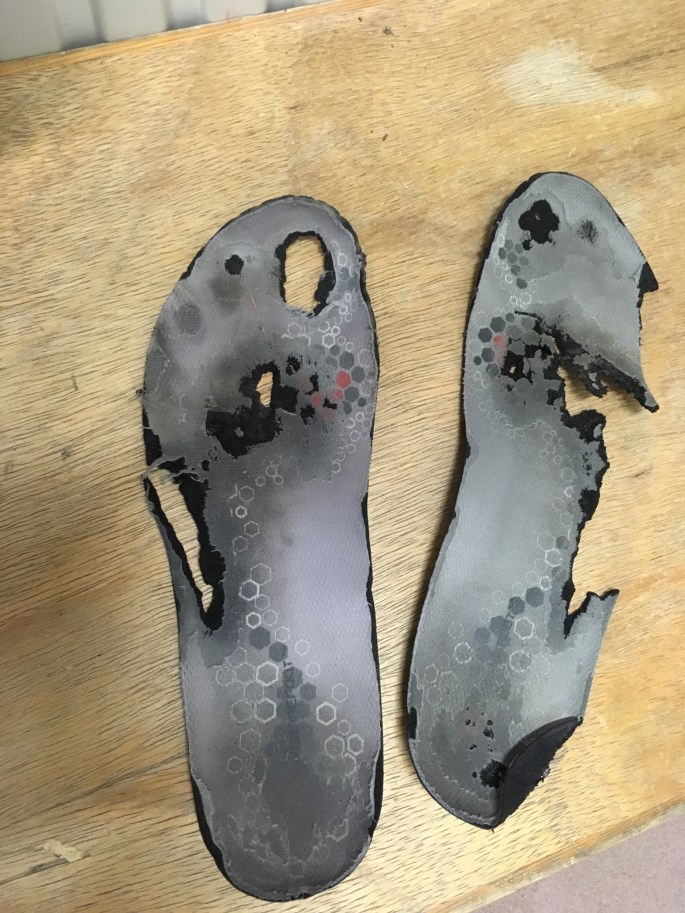
No one can argue that a running pause of 10 years and protection of your feet with bulky shoes, including a high heel to toe drop, would not alter you running style, foot/leg strength and body posture. Starting to run again, without any reflection on how to run, what to wear and when to increase milage has a high probability to get you injured. But anyone considering some little barefoot running actually did already half the job: you deal with the matter and get yourself informed, you will take care of the right posture and cadence, and you won’t start directly with a 10km run.
Naturally, one cannot simply transition from one day to another. You may end up badly injured if you do so, mainly because of the high loads on the achilles tendon due to the reduced (heel to toe) drop of your shoes and on your plantar fascia due to the lack of shoe sole support. Wearing minimalist shoes in daily life (as I do at work) will probably have additional benefits and help slowly adapting to lower drop and stronger feet.
Footnote:
After my trail-marathon in March 2019, I had the normal sore muscles and tightness that comes with such a race. I took one day off, and ran on the second day very slow for 30min in vivobarefoots without major problems. On the third day following the race, I ran to work (6k) in Nike Free, and returned from work in the same shoes. During the second half of this afternoon run, my sole under the arch started hurting badly, to my judgement from too tight shoes and too large feet (probably still a bit swollen from the race on Sunday). In the following days, running was ok for 10-20min but then pain came back in any shoes, except the barefoot models (vivobarefoot and merrell). On Sunday one week after the race I did nearly 20km in Merrell Vapor Gloves and a few days after my foot was rehabilitated.
 Fun.Run.Dad