

I am German. I am a friend of structure. I am a friend of training plans.
For most of my marathon and half marathon preparation I used plans of the famous German Marathon legend Herbert Steffny. Some people also call those the Volkswagen of Marathon plans…good, reliable, working, but nothing fancy. And as such, it naturally comprises the expected workouts (medium-long intervals, tempo runs, long runs) and some preparation races in addition.
For an ultra-trail race, a bit more alternation (in terrain, elevation, and effort) is required. For some guidance, I purchased a plan of Michael Arend Training following my fitness analysis by them. Another great source of knowledge on how to specifically train for long (and mountainous) races is the comprehensive bible Training Essentials for Ultrarunning by J. Koop and J. Rutberg.
In general, training should go from unspecific to most specific training. For example, high intensity workouts to boost VO2max are mainly done before the actual training period (in this case of 16 weeks) starts, i.e., early in the year in this case. The training is then still peppered with some higher intensity runs around lactate threshold (LT), but mainly confined to once a week only, and more and more reduced towards race day. Those LT runs should also be performed on a high grade (10-20%) to simulate the long climbs at the beginning and the end of the race (map below).
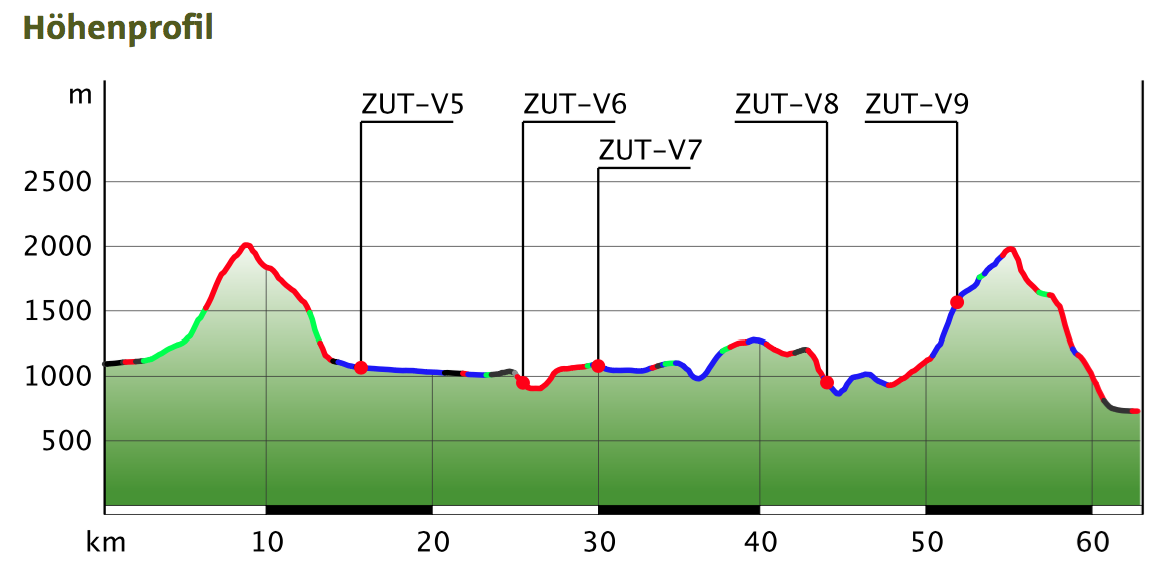
One of the most specific workouts in the case of the ZUT Supertrail are alternation runs at low (fat burning, RPE 5-6) and high (carb burning, RPE 7-8) aerobic effort. For example, 10 x 1k low and high in each zone, or 4 x 15min at higher intensity followed by 5min low intensity breaks to practice the hilly terrain during the main part of the race.
The biggest part of training, however, is run at low to moderate intensity (RPE 5-6) to improve fat burning and endurance capabilities. In addition, long power hikes above 4h every third week or so should clearly help to get over the two long climbs, which no (normal hobby earthling) runner will be able to run entirely.
A typical training week for a 6-day schedule may look like the following:
Mo off
Tue: 1-2h zone 2
Wed: Several 10min zone 4 intervals (or a longer threshold run)
Thu: 1-2h zone 2
Fr: 1-2h zone 2
Sat: Zone 2 / Zone 3 alternation (1k each zone 10-15 times)
Sun: Hike or 1.5-3h zone 2
What will be more tricky for this preparation are the elevation gain I should cover with my training. Whilst the middle part of the race is kind of well represented by the hilly terrain of the Foret de Soignes in front of my doorstep, Brussels and its surroundings clearly lack some steep slopes (10-20% grade), especially for climbs longer than just 3min. The two main ideas for overcoming this problem are inclined treadmill runs in a gym, or a kind hotel / office building that lets me use their stairs, we’ll see how that goes.
Nomenclature:
RPE: Rate of perceived exertion
For example, taking the definition of Michael Arend Training, those could be defined as
3-4 Regeneration (60-70% HFmax)
5-6 Moderate aerobic (70-80% HFmax, zone 2)
7-8 High aerobic (80-90% HFmax, zone 3)
8-9 Lactate threshold, very high (90-95% HFmax, zone 4)
10 Maximum (VO2max intervals, 95-100% HFmax, zone 5)
 Fun.Run.Dad